
Choroid Plexus Cyst – Genetic soft marker in Fetus
This blog explains what a Choroid Plexus Cyst (CPC) is, why it happens, what tests you may need, and what the diagnosis means for you and your baby.
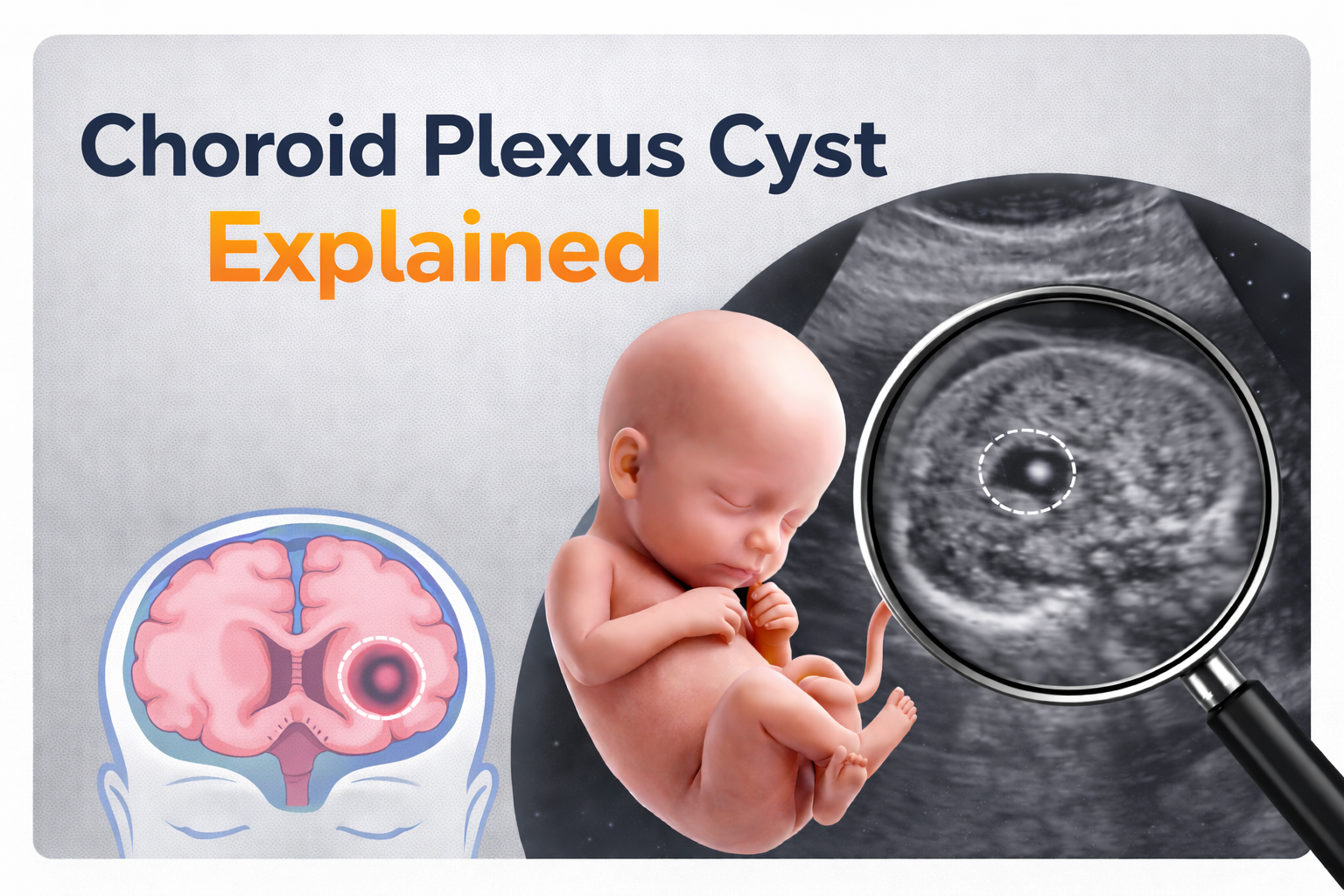
What is a Choroid Plexus Cyst?
Inside the brain, on both the left and right sides, is a structure called the choroid plexus. Its work is to make cerebrospinal fluid, the liquid that cushions and protects the brain and spinal cord.
In about 1–2% of babies, a small, round pocket of fluid — called a cyst — can appear in this area. This is known as a Choroid Plexus Cyst.
Why does it happen?
The exact reason CPCs form is not known. They are simply small fluid-filled pockets, similar to blisters. They do not involve or damage brain tissue, and they usually disappear as the baby (fetus) grows.
How are CPCs related to chromosomes?
Chromosomes carry our genetic information. Most people have 46 chromosomes, arranged in 23 pairs — one set from each parent.
Some babies have extra or missing chromosomes, such as Trisomy 18, where there is an extra chromosome number 18. About one-third of babies with Trisomy 18 have CPCs.
In pregnancies where a CPC is found:
- Around 2.1% of fetuses will have a chromosome abnormality
- Most of these babies will also have other abnormalities visible on ultrasound
- If the CPC is the only finding, the chance of a chromosome abnormality drops to about 1 in 300
What type of test are needed?
Usually a detailed ultrasound scan Including detail examination Fetal heart (Fetal Echo) to look for any other abnormalities.
- If the CPC is the only finding, additional tests are usually not needed.
- If other abnormalities are seen, your doctor or midwife may recommend further testing, such as:
- Non-invasive prenatal testing (NIPT)
- Amniocentesis for Fetal Genetic testing
A range of genetic tests may be used, including FISH, Q-f PCR, Karyotyping, Microarray analysis, and whole-exome sequencing. The final decision about which tests are most suitable will be made after evaluating multiple factors relevant to your case.
What will happen during the rest of the pregnancy?
When a choroid plexus cyst (CPC) is the only finding on ultrasound, it generally may not significantly affect pregnancy out come. In most cases, these cysts resolve on their own by approximately 28 weeks.
What does it mean after the baby is born?
Children who had an isolated CPC and normal chromosomes show no differences in brain development, motor skills, or behaviour compared with other children. General follow-up is needed after birth.
Disclaimer: This leaflet provides general information only. It is not medical advice and should not replace the personal advice, diagnosis, or treatment you get from your healthcare providers.
- Choroid Plexus Cyst
- Who is at Risk?
- Down Syndrome
- Thickened Nuchal Fold in Fetus
- Absent or Small Nasal Bone
- Echogenic intracardiac focus (EIF) in the fetal heart
- Cerebellar hypoplasia (CH) in Fetus
- Agenesis of Septum Pellucidum in Fetal Brain
- Ventriculomegaly in the Fetal Brain
- Mega Cisterna Magna – MCM
Committed to precise diagnostics, empathetic guidance, and advanced fetal care — supporting mothers and babies at every step of their journey.
Quick Links
Contact Information