Absent or Small Nasal Bone in the Fetus
This blog explains what it means when a baby’s nasal bone is absent or small on the 11-14 week ultrasound scan. It outlines why this finding occurs, what further tests may be offered, and what the results may mean for your pregnancy.
This finding does not affect the baby’s nose shape – it only helps screen for certain genetic conditions.
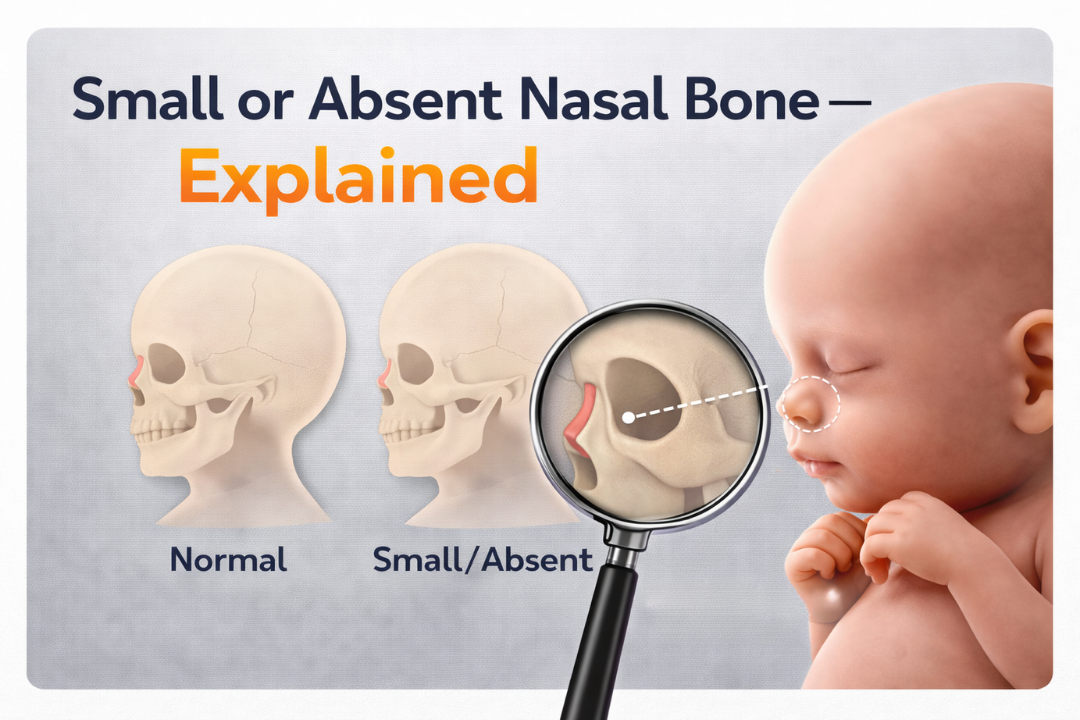
What is an absent or small nasal bone?
By 11–14 weeks of pregnancy, the fetal nasal bone is usually seen on ultrasound as a thin, bright line above the nose.
In some pregnancies, the nasal bone cannot be seen or looks small.
This does not always mean there is a problem, but it can increase the chance of certain chromosomal conditions, such as:
• Down syndrome (Trisomy 21)
• Edwards syndrome (Trisomy 18)
• Patau syndrome (Trisomy 13)
• Certain single-gene conditions
It is considered one of several “soft markers” used in early pregnancy screening
Why is the nasal bone important in screening?
Screening tests estimate risk, not a diagnosis.
An absent nasal bone can influence the accuracy of the Combined Test, which includes
• Nuchal translucency (NT) measurement
• Pregnancy hormone levels (from maternal blood)
Many centers consider a risk of 1 in 250 or higher as “increased risk,” though this threshold may vary based on your personal situation and local guidelines.
Should I have the Non-Invasive Prenatal Test (NIPT)?
NIPT is a safe blood test that examines small fragments of fetal DNA circulating in the mother’s blood. It is more accurate at detecting Trisomy 21, 18, and 13
NIPT is often offered if the Combined Test or ultrasound suggests a higher-than-expected risk. Your doctor will discuss whether NIPT or a direct diagnostic test would be more suitable for you.
When is invasive testing recommended?
If the risk is high or if the ultrasound shows additional findings, your doctor may recommend an invasive diagnostic test:
• Chorionic Villus Sampling (CVS) (11–14 weeks): a small sample of placental tissue is taken.
• Amniocentesis (from 15 weeks): a small sample of amniotic fluid is taken.
These tests provide definitive results, but both carry a small risk of miscarriage. Your doctor will explain the benefits and risks in your individual case.
What genetic tests might be performed?
Depending on your situation, one or more of the following tests may be recommended:
QF-PCR: a rapid test for trisomies 21, 18, and 13
Karyotype: looks at all chromosomes for major changes
FISH: targeted testing for specific chromosome abnormalities
Chromosomal microarray: detects smaller genetic changes not seen on a karyotype
Additional single-gene testing if indicated by scan findings and other factors
Does ethnicity affect nasal bone visibility?
Yes.
Around 4% of babies of Asian origin may naturally have a later-developing nasal bone. This means the nasal bone may be absent at the 11-14 week scan even when the baby is completely healthy. Your doctor will consider this when interpreting your results.
Will I need more scans?
If diagnostic tests are normal, you may be offered a detailed anatomy scan later in pregnancy to check the development of major organs, including the brain and heart.
In many cases, the nasal bone becomes visible on later ultrasounds.
What should I expect for the rest of the pregnancy?
If all tests are normal, your pregnancy is usually considered low risk.
No special monitoring is needed solely because the nasal bone was not seen early on.
Will this happen in future pregnancies?
Most parents do not experience this again in future pregnancies.
However, if a chromosomal condition is diagnosed, the chance may be slightly higher
- Choroid Plexus Cyst
- Who is at Risk?
- Down Syndrome
- Thickened Nuchal Fold in Fetus
- Absent or Small Nasal Bone
- Echogenic intracardiac focus (EIF) in the fetal heart
- Cerebellar hypoplasia (CH) in Fetus
- Agenesis of Septum Pellucidum in Fetal Brain
- Ventriculomegaly in the Fetal Brain
- Mega Cisterna Magna – MCM
Committed to precise diagnostics, empathetic guidance, and advanced fetal care — supporting mothers and babies at every step of their journey.
Quick Links
Contact Information