
Echogenic intracardiac focus (EIF) in the fetal heart
This blog is a resource for patients and their families who want reliable, clear, and easy-to-understand information about an Echogenic Intracardiac Focus (EIF) seen in the baby’s heart.
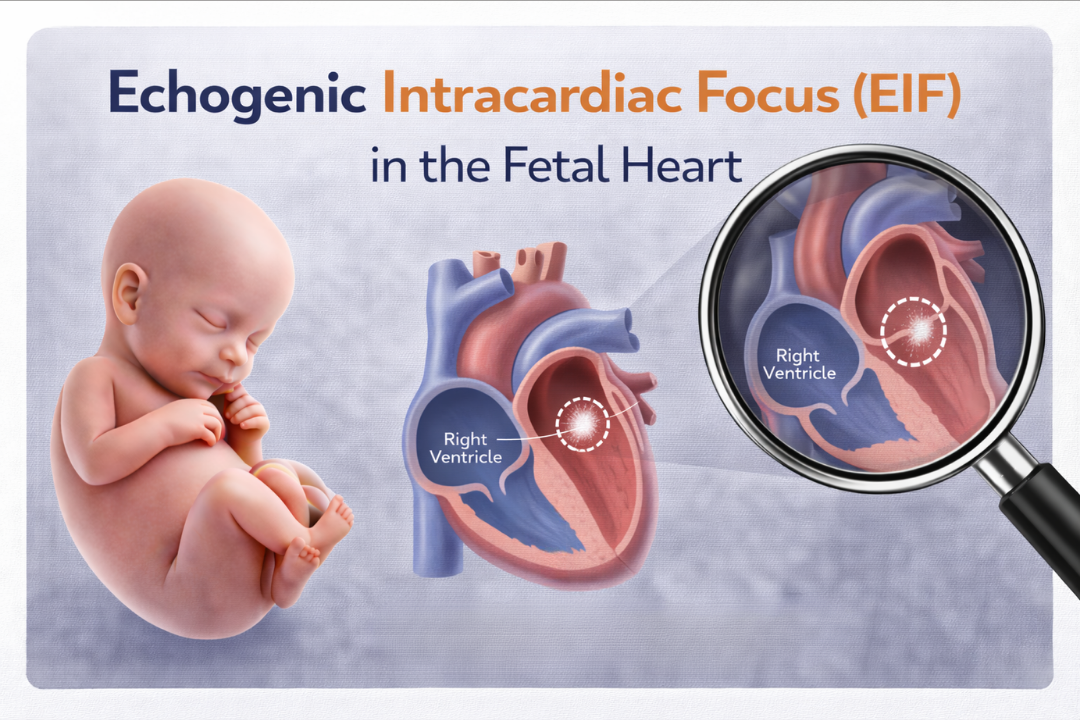
What Is an Echogenic Intracardiac Focus (EIF)?
An echogenic intracardiac focus (EIF) is a small bright spot seen inside your baby’s heart during an ultrasound scan, most commonly in the left ventricle.
• It does not affect how the baby’s heart works.
• It does not cause heart disease.
• It is simply a tiny calcium deposit in one of the small muscles inside the heart.
• It is a fairly common finding in the second and third trimester.
How Common Is It?
• About 1 in 10 babies may show an EIF on ultrasound.
• Around 4% of all pregnancies show EIF, and it is more common (up to 10%) in Asian populations.
• Some babies may have more than one EIF.
• It is not attached to the heart walls and moves normally with the heartbeat.
Does an EIF Cause Baby Health Problems?
In most cases, no.
• Babies with an isolated EIF (meaning EIF is the only finding) are usually born completely healthy with normal heart function.
• Rarely, an EIF can be seen along with chromosomal conditions, especially Down syndrome.
• When EIF is the only marker, the increase in risk is small.
Why Pay Attention to EIF?
An EIF can: Very rarely be linked to minor heart differences, or slightly increase the chance of a chromosome condition (mainly Down syndrome).
Because of these possibilities, your doctor may examine the baby’s development more closely.
What Tests Are Recommended After an EIF Is Found?
Detailed Ultrasound Scan
Your doctor may order a detailed scan to check:
• the baby’s heart structure
• the baby’s growth
• any additional soft markers for chromosome conditions
If everything else appears normal, this is very reassuring
NIPT (Non-Invasive Prenatal Test) — Optional
A Non-Invasive Prenatal Test (NIPT) is a simple blood test taken from the mother that screens for chromosome conditions such as Down syndrome. It is more accurate than traditional biochemical screening tests, such as the Quadruple Marker Test.
However, NIPT also has limitations – it cannot study all 46 chromosomes in detail, and it is not a direct diagnostic test like karyotyping. It is considered a screening test, not a confirmatory one.
NIPT works by analyzing cell-free fetal DNA present in the mother’s blood, providing a more reliable assessment of the baby’s genetic health.
Additional invasive Testing (Only If Needed)
If the detailed scan shows concerns, your doctor may discuss:
• Amniocentesis – a test of the amniotic fluid to check the baby’s chromosomes
• This is usually considered when there are:
Abnormal Biochemical or NIPT results
multiple EIFs
Advanced maternal age
previous baby with heart or genetic conditions
A genetic counsellor can guide you through your options
If Amniocentesis Results Are Normal
Most of the time, results are reassuring. If no chromosomal abnormality is found, the EIF is considered a normal variant. Routine pregnancy scans will continue as usual.
After Birth - Will My Baby Be Normal?
Yes – in almost all cases.
• Babies with an isolated EIF are generally healthy.
• Your baby’s heart and development will be checked as part of routine newborn care.
• An isolated EIF does not affect intelligence, growth, or long-term development.
Children with a normal evaluation grow up just like any other healthy child.
Will It Reoccur in the Next Pregnancy?
The recurrence risk of EIF is very low.
• EIF is not hereditary.
• It does not run in families.
• Having a baby with EIF does NOT increase the chance of EIF in future pregnancies.
• The risk remains the same as in the general population.
- Choroid Plexus Cyst
- Who is at Risk?
- Down Syndrome
- Thickened Nuchal Fold in Fetus
- Absent or Small Nasal Bone
- Echogenic intracardiac focus (EIF) in the fetal heart
- Cerebellar hypoplasia (CH) in Fetus
- Agenesis of Septum Pellucidum in Fetal Brain
- Ventriculomegaly in the Fetal Brain
- Mega Cisterna Magna – MCM
Committed to precise diagnostics, empathetic guidance, and advanced fetal care — supporting mothers and babies at every step of their journey.
Quick Links
Contact Information